Khóa học
IELTS Online
IELTS Online
Giảm đến 18%
Đăng ký ngay
Mục lục [Ẩn]
Bài đọc Meet the Hedgehog là một trong những bài kiểm tra toàn diện nhất về kỹ năng Reading IELTS, mang tính học thuật cao. Bài viết này sẽ cung cấp hướng dẫn giải chi tiết từng câu, từ những câu hỏi Matching Information hóc búa đến các dạng Multiple Choice phức tạp, giúp bạn ôn luyện Skill Reading hiệu quả và nâng cao band điểm của mình.
Meet the hedgehog
A In Norwich, England, the first housing development designed for both hedgehogs and people has been built. All through the gardens and fences is a network of pathways and holes installed just for the ancient, spiny creatures. It's a paradise that Fay Vass, chief executive of the British Hedgehog Preservation Society, calls 'absolutely fantastic'. As for the developers, they have reason to think the animals will help make home sales fantastic, too. Part of the attraction is that many people simply love hedgehogs, particularly in Britain, where children's book writer Beatrix Potter introduced Mrs. Tiggy-Winkle, a hedgehog character, over a century ago. But part of the attraction is also rooted in science. Studies have helped make clear that hedgehogs are good for gardens, eating vast numbers of slugs and other pests as they forage in the vegetation at night.
B Recent scientific studies about hedgehogs have helped explain mysteries as varied as why hedgehogs apply saliva to their entire bodies, how they have survived on the planet for 30 million years, why they chew toxic toad skins and what secrets they may hold about evolution. As one of the most primitive mammals on the planet, the hedgehog has been helping geneticists understand evolutionary relationships among mammals and even uncover 'secrets of the human genome'¹. At Duke University, for example, scientists chose the hedgehog and 14 other species to study the lineages of mammals. They determined among other things that marsupials (e.g., kangaroos) are not related to monotremes (the egg-laying platypus and echidna), which had long been a subject of debate. Such questions are not just academic. 'If you are trying to trace, for example, the evolutionary steps of foetal heart development to better understand how foetal defects occur, it helps to know which mammals are related so that you can make accurate inferences about one mammal from another mammal's development,' says researcher Keith Killian.
C Still, much about hedgehogs remains unknown. For one thing, scientists think they haven't even discovered all the hedgehog species. 'We know of at least 14,' says hedgehog researcher Nigel Reeve of Britain's University of Surrey, Roehampton. 'It's almost certain that there are more species.' The 14 known species are native to Africa and parts of Asia as well as Europe. Some hibernate through cold winters in the north. Others tolerate desert heat near the equator. Some live in urban areas, adapting well to living in close proximity to humans. Others live in areas that rank among the most remote places on the planet.
D Hedgehogs spend much of their time alone, but Reeve says it would be a mistake to think of them as solitary. 'Hedgehogs do approach each other and can detect the presence of others by their scent,' he says. 'It is true that they usually do not interact at close quarters, but that does not mean they are unaware of their neighbours. They may occasionally scrap over food items and rival males attracted to a female may also have aggressive interactions. Still, it's fair to say that, in adulthood, hedgehogs meet primarily to mate, producing litters of four or five hoglets as often as twice yearly.'
E Adult hedgehogs eat just about anything they can find: insects, snakes, bird eggs, small rodents and more. Veterinarians trying to understand gut disease in domesticated hedgehogs have concluded that the varied diet of wild hedgehogs gives them more than nutrition – the hard bodies of insects also scrape the hedgehogs’ teeth clean.
F All hedgehogs also share the same defence mechanism: they retract their vulnerable parts – head, feet, belly – into a quill-covered ball, using special skin down their sides and over their heads and feet. Any perceived threat can make them roll up, including the approach of a biologist, so researchers have invented a new measurement for the animals: ball length. Young hedgehogs have a few extra defence strategies. 'One is to spring up in the air,' says Reeve. 'A fox would get a face full of bristles. They make a little squeak while they do it.' Evidence suggests that hedgehogs may also add unpleasant chemicals to their quills to make them even less appealing. In behaviour that may be unique for a vertebrate, they chew substances laden with toxins and then apply frothy saliva to their entire bodies. In one 1977 study, human volunteers pricked themselves with quills from hedgehogs that had coated themselves after chewing on venomous toad skins. The volunteers found those quills much more irritating and painful than clean ones.
G However, every year, many thousands of the animals die on roads in Europe and elsewhere as they go about their nightly business. Along with intensive farming and pesticides, road kill has taken its toll on hedgehog populations. One 2002 study found the animal numbers had dropped by between 20 and 30 per cent in a single decade. To help combat the decline, the British have established special clinics for injured hedgehogs, urged that anyone making a bonfire check the animals underneath first, and ensured that hedgehogs can cope with cattle grids. Recently, they even persuaded McDonald's to alter the packaging of its McFlurry ice-cream container, which had been trapping foraging hedgehogs.
H Ironically, for centuries the English considered these animals as vermin. Even 50 years ago gamekeepers were killing as many as 10,000 a year thinking they were no more than bird-egg-eating pests. In some places today, scientists are coming to the same conclusions all over again. In the 1970s, hedgehogs were introduced to the Hebrides Islands of Scotland to help combat garden slugs. With no natural enemies there, a few hedgehogs soon turned into thousands. Wildlife researchers have watched the hedgehogs reduce the numbers of rare ground-nesting wading birds by feasting on their eggs. Efforts to cull the animals in the past two years have upset Britain's conservationists who have countered with strategies to relocate the animals.
>>> Xem thêm: Những sai lầm khi luyện IELTS Reading cần tránh và cách khắc phục
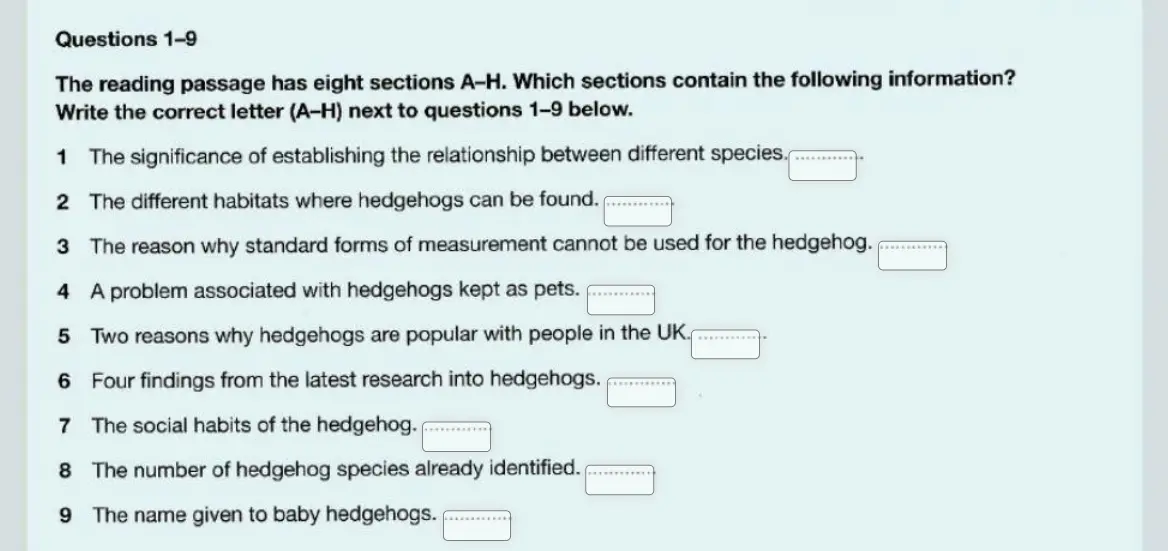
Questions 1-9
The reading passage has eight sections A–H.
Which sections contain the following information?
Write the correct letter (A–H) next to questions 1–9 below.
1. The significance of establishing the relationship between different species.
2. The different habitats where hedgehogs can be found.
3. The reason why standard forms of measurement cannot be used for the hedgehog.
4. A problem associated with hedgehogs kept as pets.
5. Two reasons why hedgehogs are popular with people in the UK.
6. Four findings from the latest research into hedgehogs.
7. The social habits of the hedgehog.
8. The number of hedgehog species already identified.
9. The name given to baby hedgehogs
Questions 9 - 13
Choose the correct answer A, B, C or D.
10. The study conducted in 1977 revealed a possible reason why
A. hedgehogs clean their quills.
B. hedgehogs chew poisonous animal skins.
C. adult hedgehogs do not leap into the air.
D. young hedgehogs make a high-pitched noise.
11. In Britain, which of the following has NOT been done to protect hedgehogs?
A. The opening of hospitals just for hedgehogs.
B. Imposing fines for littering in areas where hedgehogs live.
C. The alteration of a container produced by a fast-food chain.
D. Alerting people to the potential dangers faced by hedgehogs.
12. What are the 'conclusions' that scientists on the Hebrides Islands have reached again?
A. Hedgehog numbers are declining.
B. Hedgehogs pose a threat to other wildlife.
C. Hedgehogs can safely be introduced there.
D. Hedgehogs can be used effectively as a natural predator.
13. What would conservationists prefer to do on the Hebrides Islands?
A. Introduce a native predator of hedgehogs.
B. Kill a small number of hedgehogs.
C. Remove ground-nesting birds.
D. Move the hedgehogs elsewhere.
>> Xem thêm: Giải đề IELTS Reading: A brief history of humans and food [full answers]
|
Câu 1: B |
Câu 7: D |
|
Câu 2: C |
Câu 8: C |
|
Câu 3: F |
Câu 9: D |
|
Câu 4: E |
Câu 10: A |
|
Câu 5: A |
Câu 11: B |
|
Câu 6: B |
Câu 12: B |
|
Câu 13: D |

Giải thích chi tiết:
Question 1 - Đáp án B
The significance of establishing the relationship between different species. (Tầm quan trọng của việc thiết lập mối quan hệ giữa các loài khác nhau.)
Đoạn B đề cập: The hedgehog has been helping geneticists understand evolutionary relationships among mammals and even uncover 'secrets of the human genome'¹ (Loài nhím đã giúp các nhà di truyền học hiểu rõ hơn về mối quan hệ tiến hóa giữa các loài động vật có vú và thậm chí còn góp phần khám phá những ‘bí mật của bộ gen người’)
Phần này nêu rõ tầm quan trọng của việc biết mối quan hệ giữa các loài động vật có vú, cụ thể là giúp các nhà khoa học hiểu về sự tiến hóa của tim thai nhi và các khuyết tật thai nhi. → Đáp án B
Question 2 - Đáp án C
The significance of establishing the relationship between different species. (Ý nghĩa của việc thiết lập mối quan hệ giữa các loài khác nhau.)
Đoạn C liệt kê chi tiết các môi trường sống đa dạng của nhím: ...native to Africa and parts of Asia as well as Europe. Some hibernate... Others tolerate desert heat... Some live in urban areas... Others live in areas that rank among the most remote places on the planet. (… có nguồn gốc từ châu Phi và một số khu vực của châu Á cũng như châu Âu. Một số loài ngủ đông… Một số khác có thể chịu được cái nóng sa mạc… Có loài sống ở khu vực đô thị… Trong khi những loài khác lại sinh sống ở những nơi hẻo lánh nhất trên hành tinh.)
--> Ý nghĩa: Đoạn này bao quát phạm vi địa lý và điều kiện khí hậu khác nhau (sa mạc, đô thị, vùng xa xôi) nơi nhím sinh sống.
>> Xem thêm: Tổng hợp tài liệu luyện thi IELTS Reading miễn phí cơ bản đến nâng cao
Question 3 - Đáp án F
The reason why standard forms of measurement cannot be used for the hedgehog. (Lý do tại sao các đơn vị đo lường tiêu chuẩn không thể được sử dụng cho loài nhím.)
Giải thích (Section F):
--> Ý nghĩa: Nhím cuộn tròn thành quả bóng khi bị đe dọa, khiến các nhà khoa học không thể đo lường chúng bằng các phương pháp tiêu chuẩn thông thường và phải phát minh ra cách đo mới là "chiều dài quả bóng" (ball length).
Question 4 - Đáp án E
A problem associated with hedgehogs kept as pets. (Một vấn đề liên quan đến việc nuôi nhím làm thú cưng.)
Giải thích (Section E):
Question 5 - Đáp án A
Two reasons why hedgehogs are popular with people in the UK. (Hai lý do khiến nhím được ưa chuộng bởi người dân ở Vương quốc Anh.)
Giải thích (Section A): Đoạn A đưa ra hai lý do chính khiến nhím được yêu thích ở Anh:
(1) Sức hấp dẫn văn hóa: "...many people simply love hedgehogs, particularly in Britain, where children's book writer Beatrix Potter introduced Mrs. Tiggy-Winkle..."
(2) Lợi ích thực tế: "...hedgehogs are good for gardens, eating vast numbers of slugs and other pests..."
>> Xem thêm: Giải đề IELTS Reading: The Impact of Invasive Species [Full answers]
Question 6 - Đáp án B
Four findings from the latest research into hedgehogs. (Bốn phát hiện từ nghiên cứu mới nhất về loài nhím.)
Đoạn B liệt kê bốn bí ẩn được nghiên cứu khoa học gần đây giúp giải thích: (1) why hedgehogs apply saliva to their entire bodies; (2) how they have survived on the planet for 30 million years; (3) why they chew toxic toad skins; và (4) what secrets they may hold about evolution.
Question 7 - Đáp án D
The social habits of the hedgehog (Thói quen xã hội của loài nhím)
Đoạn D mô tả hành vi xã hội của nhím: "Hedgehogs spend much of their time alone... Hedgehogs do approach each other... They may occasionally scrap over food items and rival males... meet primarily to mate..."
--> Ý nghĩa: Đoạn này làm rõ nhím không hoàn toàn sống cô độc mà vẫn tương tác (bằng mùi hương, tranh giành thức ăn, và giao phối).
Question 8 - Đáp án C
The number of hedgehog species already identified. (Số lượng loài nhím đã được xác định.)
Trích dẫn: "We know of at least 14,' says hedgehog researcher Nigel Reeve..."
--> Ý nghĩa: Con số được xác định là ít nhất 14 loài.
Question 9 - Đáp án D
The name given to baby hedgehogs (Tên gọi nhóm con)
Trích dẫn: "...producing litters of four or five hoglets as often as twice yearly."
--> Ý nghĩa: Nhím con được gọi là hoglets.
>> Xem thêm: Giải đề IELTS Reading Left or Right [FULL ANSWER]
Question 10 - Đáp án A
The study conducted in 1977 revealed a possible reason why... (Nghiên cứu được thực hiện vào năm 1977 đã tiết lộ một lý do khả dĩ tại sao…)
Đáp án: A (hedgehogs clean their quills. - nhím làm sạch lông gai của chúng.)
Giải thích (Section F):
Question 11 - Đáp án B
In Britain, which of the following has NOT been done to protect hedgehogs? (Ở Anh, điều nào sau đây CHƯA được thực hiện để bảo vệ nhím?)
Đáp án: B (Imposing fines for littering in areas where hedgehogs live. - Áp đặt tiền phạt vì xả rác ở những khu vực nhím sinh sống.)
Giải thích (Section G):

Question 12 - Đáp án B
What are the 'conclusions' that scientists on the Hebrides Islands have reached again? (Các 'kết luận' mà các nhà khoa học trên Quần đảo Hebrides đã đạt được lần nữa là gì?)
Đáp án: B (Hedgehogs pose a threat to other wildlife. - Nhím gây ra mối đe dọa cho động vật hoang dã khác.)
Giải thích (Section H): ...scientists are coming to the same conclusions all over again... Wildlife researchers have watched the hedgehogs reduce the numbers of rare ground-nesting wading birds by feasting on their eggs. (…các nhà khoa học lại tiếp tục đi đến cùng một kết luận… Các nhà nghiên cứu về động vật hoang dã đã quan sát thấy nhím làm giảm số lượng các loài chim nước hiếm làm tổ trên mặt đất bằng cách ăn trứng của chúng.)
--> Ý nghĩa: Kết luận lặp lại là nhím đã gây hại cho các loài chim quý hiếm bằng cách ăn trứng của chúng, tức là nhím gây ra mối đe dọa cho động vật hoang dã khác.
>> Xem thêm: Giải đề IELTS Reading: How deserts are formed [Full answers]
Question 13 - Đáp án D
What would conservationists prefer to do on the Hebrides Islands? (Các nhà bảo tồn muốn làm gì trên Quần đảo Hebrides?)
Đáp án: D (Move the hedgehogs elsewhere. - Di chuyển nhím đi nơi khác.)
Giải thích (Section H): "Efforts to cull the animals... have upset Britain's conservationists who have countered with strategies to relocate the animals."
--> Ý nghĩa: Các nhà bảo tồn phản đối việc giết nhím (cull) và thay vào đó muốn di chuyển (relocate) chúng.
>> Xem thêm:
|
Từ vựng |
Dịch nghĩa |
Giải thích / Ngữ cảnh trong bài |
|
Development |
Khu nhà ở, sự phát triển |
Chỉ khu nhà ở mới được xây dựng có thiết kế đặc biệt cho nhím. |
|
Network |
Mạng lưới |
Chỉ mạng lưới lối đi (pathways) và lỗ hổng (holes) xuyên qua hàng rào. |
|
Spiny |
Có gai, đầy gai |
Tính từ mô tả những sinh vật nhím (spiny creatures). |
|
Executive |
Giám đốc điều hành |
Chức danh của người đứng đầu hiệp hội bảo tồn (chief executive). |
|
Forage |
Kiếm ăn |
Hành động nhím đi kiếm thức ăn trong thảm thực vật vào ban đêm. |
|
Pest |
Sâu bọ, vật gây hại |
Nhím ăn sên và các loại sâu bọ khác (slugs and other pests). |
|
Primitive |
Nguyên thủy, sơ khai |
Mô tả nhím là một trong những loài động vật có vú nguyên thủy nhất (most primitive mammals). |
|
Evolutionary |
Thuộc về tiến hóa |
Liên quan đến mối quan hệ tiến hóa giữa các loài (evolutionary relationships). |
|
Inference |
Sự suy luận |
Khả năng suy luận chính xác về sự phát triển của loài vật này từ loài vật khác. |
|
Marsupial |
Thú có túi |
Ví dụ: chuột túi (kangaroo). |
|
Monotreme |
Đơn huyệt (Thú đẻ trứng) |
Ví dụ: thú mỏ vịt (platypus) và thú lông nhím (echidna). |
|
Solitary |
Sống đơn độc |
Thảo luận về việc nhím có phải là loài sống đơn độc (solitary) hay không. |
|
Quill |
Lông gai (của nhím) |
Bộ phận bảo vệ chính của nhím. |
|
Venomous |
Có nọc độc |
Nhím nhai da cóc có nọc độc (venomous toad skins). |
|
Domesticated |
Đã được thuần hóa (nuôi tại nhà) |
Nhắc đến vấn đề sức khỏe của nhím được nuôi (domesticated hedgehogs). |
|
Toll |
Tổn thất, thiệt hại |
Đường sá đã gây ra tổn thất (taken its toll) cho quần thể nhím. |
|
Vermin |
Vật gây hại, sâu bọ |
Cách người Anh từng coi nhím trong lịch sử. |
|
Cull |
Tiêu hủy, loại bỏ có chọn lọc |
Nỗ lực tiêu hủy nhím để bảo vệ chim (Efforts to cull the animals). |
|
Relocate |
Di dời, chuyển chỗ |
Chiến lược mà các nhà bảo tồn muốn thực hiện thay vì tiêu hủy (relocate the animals). |
|
Conservationist |
Nhà bảo tồn |
Chỉ những người hoạt động trong lĩnh vực bảo tồn động vật hoang dã. |
>> Xem thêm: Thời gian làm Reading IELTS: Chiến lược phân bổ và mẹo làm bài hiệu quả
Để đạt được band điểm IELTS cao người học cần một lộ trình luyện thi rõ ràng, môi trường giao tiếp thực tế và sự hướng dẫn từ giảng viên có chuyên môn cao. Trong số nhiều lựa chọn hiện nay, Langmaster được đánh giá là trung tâm luyện thi IELTS online uy tín tốt nhất dành cho người mất gốc cũng như người mới bắt đầu.
Khóa học IELTS Online tại Langmaster được thiết kế dựa trên giáo trình chuẩn đề thi thật, kết hợp học cá nhân hóa và phản hồi 1-1 từ giảng viên 7.5+ IELTS, giúp học viên phát triển toàn diện cả 4 kỹ năng: Listening, Speaking, Reading, và Writing.

Ưu điểm nổi bật của khóa học IELTS Online Langmaster:
Nếu bạn đang tìm kiếm khóa học IELTS online tốt nhất, phù hợp cho cả người mới bắt đầu lẫn người mất gốc, Langmaster chính là lựa chọn đáng tin cậy để bứt phá band điểm IELTS mơ ước.
Hãy đăng ký khóa IELTS online tại Langmaster ngay hôm nay để nhận được buổi HỌC THỬ MIỄN PHÍ trước khi đăng ký.
KẾT LUẬN: Như vậy, chúng ta đã vừa cùng nhau phân tích và giải chi tiết đề IELTS Reading Meet the Hedgehog. Bài viết đã làm rõ các kỹ năng cần thiết để tìm thông tin, nhận biết từ khóa và áp dụng chiến lược đọc hiểu hiệu quả. Hy vọng hướng dẫn này sẽ giúp bạn tự tin hơn khi làm bài và cải thiện điểm số Reading IELTS. Chúc bạn học tập hiệu quả và đạt kết quả cao trong kỳ thi IELTS sắp tới!




Các dạng bài phổ biến và tiêu chí chấm điểm IELTS Reading chi tiết nhất: Multiple Choice, Matching Information, Matching Headings,... và hướng dẫn chiến lược làm bài hiệu quả
Những sai lầm khi luyện IELTS Reading bao gồm: dịch từng từ, đọc hết cả bài, không đọc câu hỏi trước, không quản lý thời gian, không nắm vững kỹ năng paraphrase, viết sai chính tả
![Giải đề IELTS Reading: A brief history of humans and food [full answers]](https://langmaster.edu.vn/storage/images/2025/09/20/a-brief-history-of-humans-and-food-ielts-reading-answers.webp)
Giải đề thi IELTS Reading “A brief history of humans and food” kèm full đề thi thật, câu hỏi, đáp án, giải thích chi tiết, và từ vựng cần lưu ý khi làm bài.
Tổng hợp IELTS Reading tips hay nhất giúp bạn đọc nhanh, nắm ý chính và xử lý thông tin chính xác, tự tin đạt điểm cao trong kỳ thi IELTS.
![Giải đề IELTS Reading: The importance of law [Full answers]](https://langmaster.edu.vn/storage/images/2025/09/22/55.webp)
Giải đề IELTS Reading “The importance of law” kèm đáp án chi tiết, từ vựng quan trọng và bí quyết luyện thi hiệu quả để nâng cao band điểm.





Hơn 16 năm kinh nghiệm, đào tạo thành công 800.000+ học viên
Phương pháp giảng dạy hiện đại, học viên tiến bộ rõ rệt
Lộ trình học chuẩn quốc tế, phù hợp với nhu cầu thực tiễn
Giáo viên đạt chuẩn Quốc tế với chất lượng top đầu thị trường, giàu kinh nghiệm
Học online linh hoạt, cam kết đầu ra bằng văn bản

![Giải đề Nature or Nurture IELTS Reading Practice test [FULL ANSWER]](https://langmaster.edu.vn/storage/uploads/original/2025/10/22/nature-or-nurture-ielts-reading.png)
![Giải đề IELTS Reading: How deserts are formed [Full answers]](https://langmaster.edu.vn/storage/uploads/original/2025/10/22/ielts-reading-how-deserts-are-formed.png)

![Roman shipbuilding and navigation [IELTS Reading Cambridge 16 – Test 3]](https://langmaster.edu.vn/storage/uploads/original/2025/10/23/roman-shipbuilding-and-navigation.png)
![Giải đề Learning to Work IELTS Reading with Location [FULL ANSWER]](https://langmaster.edu.vn/storage/uploads/original/2025/10/28/learning-to-walk-ielts-reading.png)